Urban Kayaking in Berlin: Paddling the Landwehrkanal from Kreuzberg to the Spree
The Lenné Canal: 175 Years of Urban Engineering
The Landwehrkanal is not a natural river; it is a meticulously engineered navigation cut. In the 1840s, shallow rapids and sandbars on the natural Spree river repeatedly grounded freight barges delivering Silesian coal and Bavarian timber to central Berlin.
King Friedrich Wilhelm IV commissioned Prussia’s premier royal landscape architect, Peter Joseph Lenné, to design a bypass canal. Lenné, famous for designing the sprawling parklands of Potsdam's Sanssouci Palace and Berlin's Tiergarten, refused to construct a purely industrial ditch.
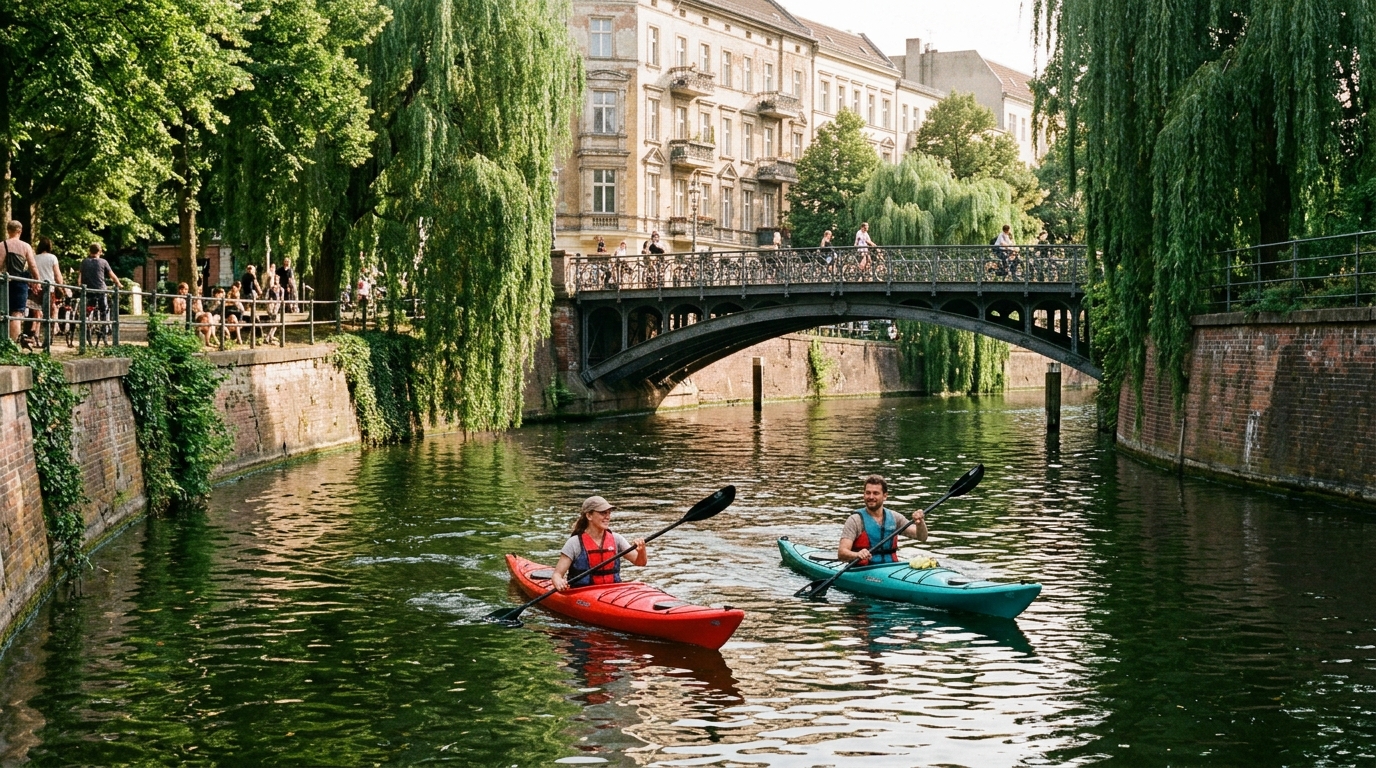
Built between 1845 and 1850 by thousands of workers armed only with shovels and wheelbarrows, Lenné designed the canal as an integrated civic parkway. He sloped the earth embankments, lined the water’s edge with double rows of weeping willows, horse chestnuts, and linden trees, and installed wide pedestrian promenades along the water.
The canal officially opened in 1850 and quickly became the industrial workhorse of the city. Later widened and fortified with granite and brick masonry seawalls between 1883 and 1890, the waterway served as a vital freight highway through the early 20th century. During the Cold War, sections of the canal marked the boundary between the American and Soviet sectors.
Today, commercial coal barges have vanished, replaced by tour boats, swan families, floating houseboats, and a vibrant community of urban paddlers.
The Classic Route: Urbanhafen to the Flutgraben
While the entire canal is navigable, the most dynamic urban section stretches from Urbanhafen in Kreuzberg eastward toward the Spree confluence in Treptow.
Launching from the calm basin of Urbanhafen—once a major freight harbor for coal and brick schooners, now a leafy basin framed by the Carl-Mosterts-Park—you paddle past the restored floating restaurant ship Van Loon.
Heading east along the tree-canopied channel between Maybachufer (Neukölln) and Paul-Lincke-Ufer (Kreuzberg), you glide beneath historic wrought-iron arched bridges:
- Admiralbrücke: As you pass beneath its stone abutments, the acoustic echoes of acoustic guitars and chatter from the evening crowds sitting along the bridge railings drift down to your kayak.
- Kottbusser Brücke: The canal passes directly beneath the bustling Turkish market at Maybachufer, where aromas of grilled gözleme, toasted sesame bread, and roasted coffee waft across the water.
- The Flutgraben & Schlesisches Tor: Near the eastern terminus, the canal splits into the Flutgraben bypass. Here, you paddle past the famous rustic wooden sundecks of Club der Visionäre and Freischwimmer, where willow branches dip directly into the water and daylight minimal-house beats provide a soundtrack to your stroke.
Pay close attention to Berlin waterway regulations regarding the main Spree. Kayaks and unpowered personal watercraft are strictly forbidden on the central Spree between Lessingbrücke and Mühlendammschleuse (the government district past the Reichstag and Museum Island) due to heavy commercial passenger traffic. When exiting the Landwehrkanal into the Spree at Treptow, stick strictly to the right bank and head upstream toward the Insel der Jugend in Treptower Park, or retrace your steps along the quiet canal.
Waterway Etiquette and Safety Rules
Paddling through a dense European capital requires following maritime law. Berlin's waterways are actively patrolled by the Wasserschutzpolizei (Water Police), who enforce federal navigation rules strictly:
1. Commercial Right of Way
Motorized commercial tour vessels (*Ausflugsschiffe*) and municipal work barges always have absolute right of way. In narrow canal sections, their large diesel engines create substantial prop wash and displacement wakes. Always paddle along the right-hand shoreline (*Rechtsfahrgebot*), yield early when encountering an oncoming ferry, and cross the channel at a clean 90-degree angle only when the water is completely clear.
2. The Lock Passages (Schleusen)
The Landwehrkanal's water level is maintained by two historic working locks: the Oberschleuse (Upper Lock) near Schlesisches Tor and the Unterschleuse (Lower Lock) near the Berlin Zoo.
Paddlers can enter the lock chambers behind commercial boats if signaled by the lockmaster’s green traffic lights, or use the concrete portage rollers located on the canal bank to pull your kayak around the lock gates on foot.
3. Zero-Alcohol Enforcement
While enjoying a beer along the canal bank is a cherished Berlin ritual, German boating laws treat kayak pilots identically to automobile drivers. The legal blood alcohol limit on federal waterways is 0.5 per mille (and strictly 0.0 for novice operators). Fines for operating watercraft while intoxicated are substantial and can result in points on your motor vehicle driver’s license. Save the cold draft beers for the riverside beer garden after you dock.
Paddling Logistics: Rentals and Launch Points
- Kayak & Canoe Rentals: Several reliable outfitters operate along the waterway, including Kanuverleih Berlin at Urbanhafen, Ahoi Ostkreuz near the Spree confluence, and BackaTour at Treptower Park. Rentals typically range from €15 to €25 per hour, or €50 to €70 for a full-day tour, including paddles and buoyancy vests.
- Personal Packrafts & Inflatables: If bringing your own inflatable kayak or SUP, the easiest entry points with low wooden docks or sloping grass banks are at Urbanhafen (Carl-Mosterts-Park) and the Lohmühleninsel floating docks.
- Best Seasons: May through September offers warm weather and lush green willow canopies. Early mornings on weekends (before 10:30 AM) offer the calmest water before commercial sightseeing boats begin their daytime runs.


Comments
Post a Comment