Exploring Berlin: Tempelhofer Feld
Imagine standing on a massive concrete runway where history literally took flight. Now, instead of boarding a plane, you're cracking open a cold Späti beer while a kite surfer zips past you on a skateboard. Welcome to Tempelhofer Feld, Berlin’s ultimate monument to reclaiming the city. It’s a vast, echoing space where Nazi-era architecture meets radical democratic urbanism, creating an energy you won't find anywhere else in Europe. If you want to understand the chaotic, beautiful heart of modern Berlin, you don't look at the Brandenburg Gate. You look right here, on this endless stretch of tarmac.
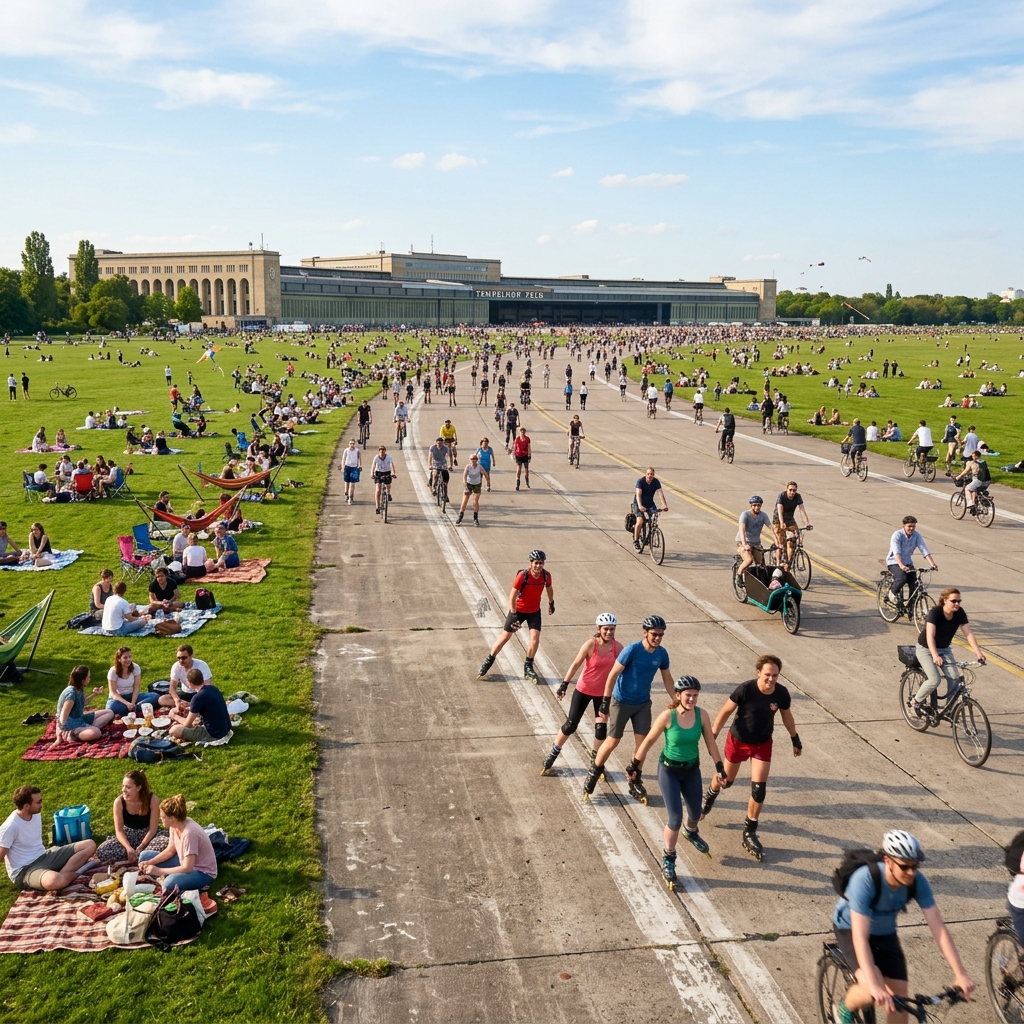
From Runways to Rollerblades: The Unmistakable Vibe
Berlin doesn't do normal parks. In almost any other global capital, a decommissioned inner-city airport would be swiftly bulldozed. It would inevitably make way for luxury condos, corporate headquarters, or anodyne shopping malls. Not here. Here, 386 hectares of pure, unadulterated asphalt and grass have been handed back to the people.
To put that in perspective, it’s larger than the entire principality of Monaco. It feels even more chaotic, in the absolute best way possible. On any given Tuesday afternoon, you’ll find a bizarre cross-section of Berlin’s eccentric ecosystem coexisting in perfect harmony.
Expat tech workers attempt to roller-skate for the first time, inevitably eating pavement near the old taxiways. Local grandmas tend to guerilla gardens bursting with tomatoes, sunflowers, and rogue pumpkins. Sound systems strapped to cargo bikes blast everything from minimal techno to 90s hip-hop. It’s loud, it’s proud, and it’s unapologetically Berlin. There is no dress code, no entry fee, and seemingly no rules other than mutual respect.
A Brief, Chaotic History: How We Got Here
The Dark Era and Aviation Dreams
To understand the sheer weight of this space, you have to look back. Originally a sprawling parade ground for Prussian military forces, it morphed into an aviation testing site in the early 20th century. Pioneers of flight tested bizarre contraptions here. By 1923, it officially opened, becoming one of the world's very first commercial airports.
But the colossal limestone terminal building that curves around the field like a stone eagle? That’s pure, terrifying Nazi architecture. Built between 1936 and 1941, it was designed by Ernst Sagebiel under the direction of Albert Speer. It was meant to be the awe-inspiring gateway to "Germania," Hitler's envisioned global capital. Walking past its imposing facade today, its scale is a stark reminder of a dark past. Yet, it has been brilliantly repurposed for a radically different, democratic present.
The Lifeline: The Berlin Airlift of 1948
Fast forward to the bitter aftermath of WWII. Berlin was a broken city, physically divided and politically tense. In 1948, the Soviet Union boldly blocked all land and water routes into West Berlin. It was a brutal attempt to starve the city into political submission. The response from the West was immediate and staggering: one of the most audacious logistical feats in human history, known as the Berlin Airlift.
For 15 exhausting months, American and British pilots flew over 200,000 missions. They dropped essential supplies—food, coal, medicine, and famously, tiny parachutes of candy for the children—straight onto Tempelhof's runways. Planes landed every few minutes, around the clock. The airport transformed overnight from a symbol of fascist megalomania into a beacon of freedom and survival. It forged a deep, enduring, and emotional bond between Berliners and the Allied forces.
The Fight for the Field: A Citizen's Victory
Tempelhof continued operating for decades, a quirky inner-city airport beloved by many for its convenience. But by 2008, it was bleeding money, planes were getting too large, and air traffic was redirected to Schönefeld (and eventually BER). The gates locked. The tarmac went quiet. Then came the developers, smelling profit.
The city government unveiled grand plans: commercial zones, high-rise apartments, the usual gentrification playbook. But Berliners weren’t having it. A massive, fiercely organized grassroots movement called "100% Tempelhofer Feld" was born. They argued the city needed this "green lung" more than it needed expensive flats. In a historic 2014 referendum, citizens voted overwhelmingly to protect the space entirely. It was a massive middle finger to corporate development. Now, it belongs strictly to the kite-boarders, the urban gardeners, and you.
The Culture of Hanging Out: What to Actually Do
Urban Gardening at Allmende-Kontor
One of the most fascinating micro-communities within the park is the Allmende-Kontor. It's a sprawling, anarchic urban garden built entirely in raised beds. You can't dig into the runway tarmac, after all! Made from old shipping pallets, discarded bathtubs, and repurposed shopping carts, it’s a patchwork of civic agriculture.
It’s not just about growing organic zucchini; it’s a vital social hub. People swap rare seeds, share stories, and build community in the shadow of the old radar tower. It’s a testament to the DIY spirit that defined post-wall Berlin. Wandering through the quirky plots feels like stumbling into a whimsical, sustainable village.
Wind, Wheels, and Weird Sports
Because there are virtually no obstacles and the wind whips freely across the flat expanse, Tempelhofer Feld has become a mecca for wind-powered sports. You’ll see landboarding, where adrenaline junkies are pulled on oversized skateboards by massive, colorful kites. You’ll see unicyclists juggling fire. You’ll see massive, impromptu group yoga sessions.
The sheer scale of the runways invites big movement. If you have anything with wheels, this is your ultimate playground. Just watch out for the dedicated speed lane. The hardcore cyclists out here do not mess around, and they will absolutely yell at you if you wander into their path holding a pretzel.
The Unexpected Urban Wilderness
Beyond the humans, Tempelhofer Feld has quietly become one of Berlin's most vital ecological sanctuaries. Because the sprawling grassy areas between the runways have been largely left untouched, nature has reclaimed the space with a vengeance. It’s a surreal juxtaposition: the harsh concrete of the aviation era surrounded by a thriving, wild meadow ecosystem.
If you wander away from the busy paved paths, you’ll find a haven for urban wildlife. The park is famously home to the endangered skylark, a ground-nesting bird that thrives in the tall, undisturbed grasses. To protect them during breeding season, large sections of the meadow are cordoned off—a stark reminder that this space belongs to nature just as much as it belongs to the city’s residents.
And then, there are the sheep. Yes, actual sheep. Instead of bringing in loud, polluting lawnmowers to manage the massive expanses of grass, the city employs a flock of grazing sheep. Watching a shepherd herd them across a former military airfield while a group of teenagers practice breakdancing nearby is a scene that encapsulates the beautiful, contradictory essence of modern Berlin.
The Ultimate Sunset Ritual
As the day winds down, the true, enduring magic of the Feld reveals itself. The horizon here is vast and entirely unobstructed by buildings, a rarity in any major city. It offers some of the most spectacular, fiery sunsets in all of Berlin.
Groups gather with picnic blankets, portable grills (only in designated zones, please don't ruin the grass!), and clinking crates of Augustiner beer. As the sky turns bruised shades of purple, pink, and bright orange, the chaotic energy of the day settles. It morphs into a collective, contented buzz. This is the ultimate Berlin living room, where strangers become friends over shared lighters and cheap wine.
Why You Need to Go Now, Not Later
Berlin is gentrifying rapidly. The legendary empty lots and squats are disappearing, replaced by start-up offices. The raw, unpolished edges that made the city famous in the 90s and 00s are being slowly smoothed over. Tempelhofer Feld is a stubborn, beautiful holdout against this tide.
It’s a massive, empty void in the middle of a dense European capital, and that emptiness is its greatest asset. It forces you to just be. You don't have to consume anything. You don't have to buy a ticket. You just exist in the space.
Whether you're nursing a brutal clubbing hangover with a greasy kebab, or training for a marathon on the 6-kilometer outer loop, the park accepts you. It is a monument to the city's complicated history, its rebellious spirit, and its unwavering commitment to public life. Don't just tick it off a sightseeing list. Buy a cheap frisbee, grab a drink, and happily lose a whole afternoon here.
Actionable Takeaway
Your mission is simple: Rent a bike. The park is far too big to fully appreciate on foot without exhausting yourself. Grab some fresh snacks from a Turkish bakery in nearby Neukölln, enter through the Columbiadamm gates, and ride the entire length of the main runway. Find a sunny spot in the grass near the community gardens, crack open a beverage, and simply watch the world go by.
References / Further Reading
- Visit Berlin: Tempelhofer Feld Official Guide - Practical info for your visit.
- The Guardian: How Berliners Reclaimed Tempelhof - A deep dive into the 2014 referendum.
- Goethe-Institut on the History and Future - Understanding the architectural and cultural impact.


Comments
Post a Comment