Urban Nation & The Bülowstraße Murals: How Schöneberg Became Berlin’s Open-Air Street Art Canvas
The Architecture of GRAFT: Bringing the Street Indoors
The biggest dilemma in curating street art is philosophical: how do you bring an art form defined by grit, illegal adrenaline, and monumental outdoor scale inside four walls without neutering its soul?
To solve this paradox, URBAN NATION enlisted the acclaimed Berlin architectural firm GRAFT. Rather than creating generic white-cube gallery rooms, GRAFT gutted the interior of a classic Gründerzeit (late-19th-century) residential building at Bülowstraße 7. They stripped away intermediate ceilings and erected a high-flying suspended runway system: a multi-tiered steel catwalk that zigzags through the cavernous vertical void like an urban skybridge.
Visitors walk along these elevated bridges, experiencing art from the same perspectives that street artists work—looking up at monumental two-story canvases, peering down at sprawling floor installations, and inspecting tactile spray textures at eye level.
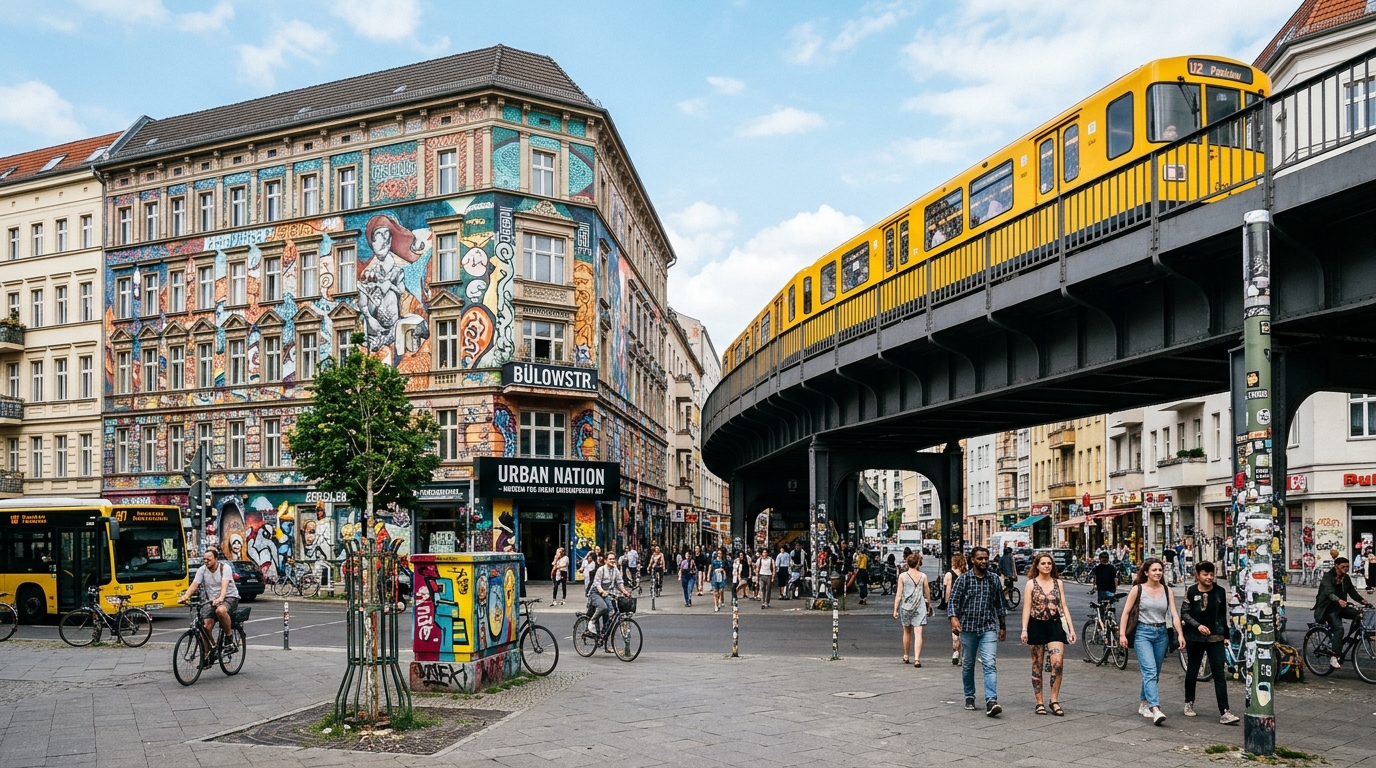
Even more radically, the museum treated its own building envelope as an evolving artwork. The entire exterior corner façade facing Bülowstraße and Zietenstraße is repainted for every major thematic exhibition by invited international artists. It functions as an enormous billboard of rebel culture that changes every few seasons, ensuring the building never becomes a static landmark.
The Open-Air Gallery: The Bülowstraße Street Art Mile
Stepping outside the museum doesn't mean leaving the exhibition. The entire length of Bülowstraße—stretching from Nollendorfplatz eastward toward Gleisdreieck Park—operates as a curated open-air gallery known as the ONE WALL Project.
As the iconic yellow U-Bahn trains of the elevated U2 line rumble overhead on their century-old iron viaducts, multi-story apartment facades on both sides of the boulevard showcase monumental murals by some of the most celebrated figures in contemporary urban art:
- Vhils (Alexandre Farto): Rather than painting on walls, the Portuguese master uses jackhammers, chisels, and controlled explosives to carve monumental portraits directly out of the layered brick and plaster surfaces of Schöneberg apartment blocks.
- Shepard Fairey (Obey): The legendary American artist behind the iconic Obama "Hope" poster has created several intricate, politically charged stencil murals blending Russian constructivism and vintage Americana along the corridor.
- Herakut: The German artist duo (Hera and Akut) combine photorealistic portraiture with raw, emotional spray lines, creating whimsical, oversized figures carrying poetic bilingual messages of hope and tolerance.
- Local Berlin Crews: The walls and utility boxes around the museum feature authentic tags and pieces from legendary Berlin graffiti collectives like 1UP (One United Power) and Berlin Kidz, demonstrating that the museum embraces grassroots street culture alongside museum-grade icons.
Before you head into the main galleries, ask the staff at the welcome desk to direct you to the Martha Cooper Library on the upper floor. Named after the legendary New York photojournalist whose 1984 book Subway Art became the bible for first-generation graffiti writers across the globe, the library holds an extraordinary archive of rare fanzines, photo albums, and artist sketchbooks documenting the underground evolution of graffiti from 1970s New York to 21st-century Berlin.
Social Roots: Art as Community Renewal
What makes URBAN NATION unique in the landscape of European cultural institutions is its underlying funding model. The museum was not established by private billionaire collectors or municipal tourism bureaus; it was created by the Stiftung Berliner Leben, a charitable foundation established by Gewobag, one of Berlin’s largest municipal social housing associations.
Bülowstraße has historically been one of Berlin’s grittiest, most complex urban crossroads, known for decades as a center for sex work, immigrant communities, and countercultural ferment. Rather than using contemporary art as a blunt instrument of corporate gentrification, URBAN NATION integrates neighborhood youth directly into workshops, hosts artist residencies in community apartments, and ensures that the residents living in the surrounding social housing can enjoy world-class culture right on their doorsteps without paying a single euro.
Visitor Logistics and Planning Your Visit
Visitor Essentials & Street Art Walking Guide
- Address: Bülowstraße 7, 10783 Berlin-Schöneberg
- Opening Hours:
- Tuesday & Wednesday: 10:00 AM – 6:00 PM
- Thursday through Sunday: 12:00 PM (Noon) – 8:00 PM
- Monday: Closed
- Admission: Free entry for all individual visitors (voluntary donations welcomed). No pre-booked tickets required. Groups of 8 or more should register in advance via their website.
- Getting There via Transit: Take the U-Bahn lines U1, U2, U3, or U4 to Nollendorfplatz (a 3-minute walk away), or take the U2 directly to Bülowstraße station. Bus routes M19, M48, M85, and 106 stop right outside.
- Walking Route Recommendation: Start at Nollendorfplatz station, walk east along Bülowstraße to admire the street murals, tour URBAN NATION, and continue east under the elevated tracks to Gleisdreieck Park and the BRLO Brwhouse craft beer container park for post-art refreshments.


Comments
Post a Comment