The Maybachufer Turkish Market: Sizzling Gözleme, Späti Culture, and the Soul of Kreuzkölln’s Landwehr Canal
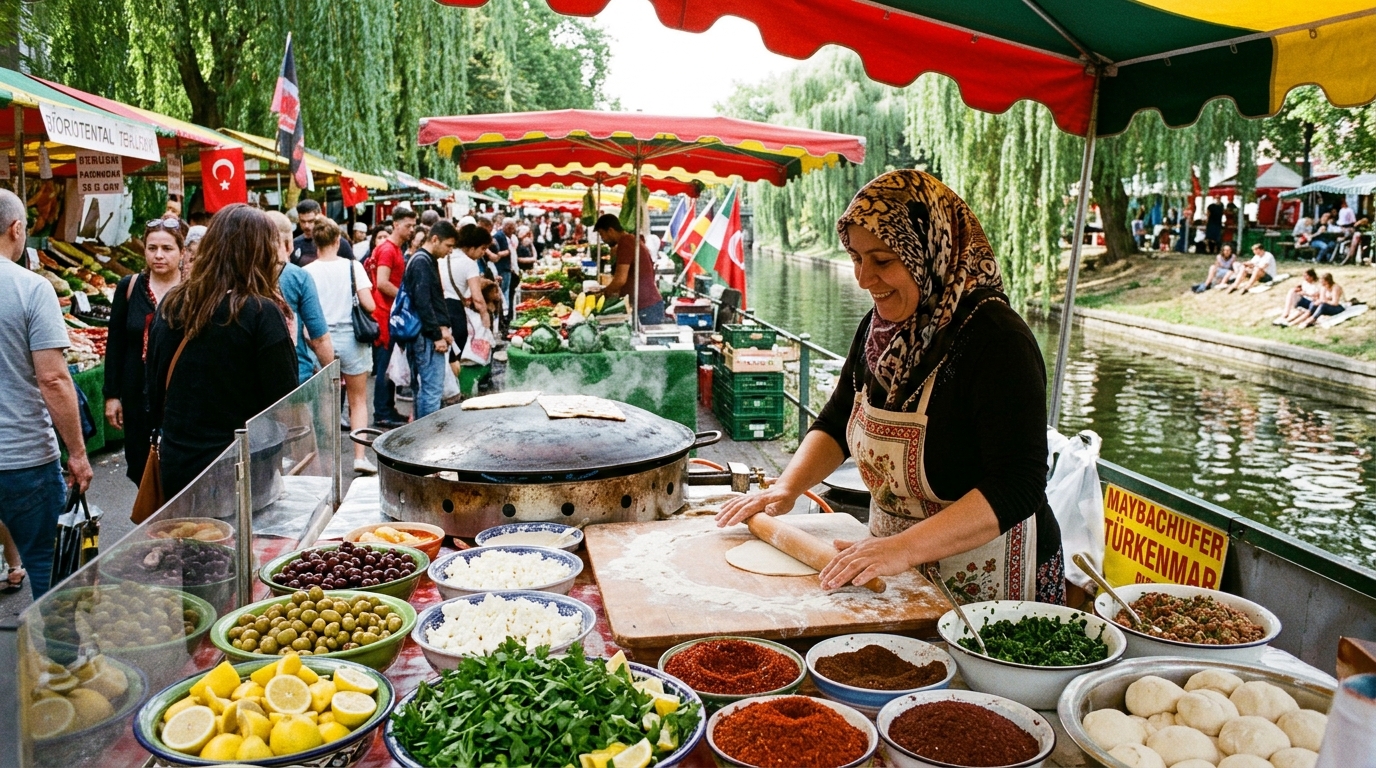
The Anatomy of the Feast: What to Eat at Maybachufer
The golden rule of visiting Maybachufer is simple: never arrive on a full stomach. While supermarkets across Berlin sell shrink-wrapped produce under fluorescent lights, the Maybachufer market is a glorious avalanche of hyper-fresh ingredients and hot, freshly griddled Anatolian street food.
Your culinary tour should begin with the holy grail of Berlin market comfort food: **gözleme**. At the central food stalls, Turkish aunties (*teyzeler*) in traditional headscarves and floral aprons roll translucent sheets of yeast dough paper-thin using long wooden rolling pins (*oklava*). The dough is generously layered with fillings before being folded and dropped onto blistering, convex cast-iron griddles called *sac*:
- Ispanaklı Peynirli (Spinach and Feta): The classic choice—tender steamed spinach leaves paired with salty, crumbly sheep’s milk cheese that softens into melted decadence.
- Kıymalı (Spiced Minced Lamb & Beef): Ground meat sautéed with onions, crushed red pepper flakes (*pul biber*), and black pepper, brushed with melted butter right off the griddle.
- Patatesli (Seasoned Potato): A hearty, warming mix of mashed russets, caramelized onions, and fresh parsley with a crispy golden-brown blistered crust.
Beyond the gözleme stands, hunt down the deep-fried, spiraled cheese **börek**, hot falafel wraps drizzled in tangy tahini and house-made fermented chili paste, and grilled halloumi sandwiches pressed hot in crusty sesame buns.
Don't skip the cold provisions either. Vendor tables are stacked high with dozens of varieties of marinated olives—garlic-stuffed colossal greens, sundried kalamatas tossed in oregano, and fiery smoked black olives. Pair them with fresh tubs of spicy *acılı ezme* (tomato-walnut relish), creamy whipped feta spread (*haydari*), and stacks of pillowy Turkish flatbread (*pide*) or ring-shaped sesame breads (*simit*) that cost barely a fraction of bakery prices.
Timing is everything at Maybachufer. If you want the freshest selection of heirloom tomatoes, herbs, and bakery treats without claustrophobic bottlenecks, arrive between 11:30 AM and 1:00 PM. But if you are on a tight budget or seeking peak urban theater, come around 5:30 PM. As vendors prepare to pack down, prices drop through the floor: you can easily score three boxes of ripe strawberries, gigantic bunches of fresh mint and coriander, and avocados for two euros. Grab a bottle of cold Club-Mate or Sternburg from the Späti on the corner of Kottbusser Damm, cross the pedestrian bridge to Paul-Lincke-Ufer, and watch the local boules players beneath the plane trees.
From Guest Workers to Cultural Anchor: The Roots of Kreuzkölln
The Maybachufer market is not an artificial tourist staging; it is an organic outgrowth of West Berlin’s postwar immigration history. In October 1961—just two months after the construction of the Berlin Wall sealed off the city’s eastern labor pool—West Germany signed a formal labor recruitment treaty (*Anwerbeabkommen*) with the Republic of Turkey.
Thousands of Turkish *Gastarbeiter* (guest workers) moved to Berlin to rebuild its factories, transit lines, and infrastructure. Because Kreuzberg (SO36) and northern Neukölln were bordered on three sides by the Berlin Wall, the historic 19th-century *Altbau* apartment buildings were cheap, run-down, and slated by urban planners for eventual clearance. Turkish families settled in these affordable quarters, transforming vacant shopfronts into bakeries, butcher shops (*kasap*), and greengrocers.
In the late 1970s, community elders organized an open-air market along the canal to trade specialty ingredients impossible to find in German supermarkets: grape leaves for dolma, Turkish peppers, sheep’s milk cheeses, and halal meats. Over the subsequent four decades, as the Wall fell and Berlin transformed into an international creative capital, the market grew into a living cultural crossroads where Turkish grocers, Lebanese bakers, German pensioners, international tech expats, and Kreuzberg artists share the exact same cobblestones.
Canal-Side Living: Weeping Willows, Swans, and Späti Culture
What truly elevates the Maybachufer experience is the surrounding ecosystem of the Landwehrkanal. Built between 1845 and 1850 under the direction of master Prussian landscape architect Peter Joseph Lenné, the 10.7-kilometer canal was originally designed to transport coal and construction bricks between the upper and lower Spree River while draining low-lying marshlands.
Today, Lenné’s landscaped banks are Berlin’s communal living room. After filling your canvas tote bags with gözleme, baklava, and fresh fruit, follow the crowds out of the market lane onto the grassy bank. Here, willow branches sweep into the green water as mute swans and crested grebes paddle past retro motorboats and inflatable kayaks.
The neighboring streets of the Reuterkiez and Paul-Lincke-Ufer boast some of Berlin's best independent culinary spots:
- Concierge Coffee (Paul-Lincke-Ufer 39-40): Tucked into a microscopic former gatehouse archway, serving expertly pulled flat whites and single-origin filter roasts.
- Pop Café (Maybachufer 8): A sunny canal-facing terrace famous for its Shakshuka, fresh juices, and vegan brunch plates.
- Brammibal's Donuts (Maybachufer 8): Berlin’s pioneer 100% plant-based donut empire started right here on this canal bank, turning out flavors like salted caramel hazelnut and Boston cream.
Visitor Logistics and Planning Your Visit
Visitor Essentials & Market Details
- Location: Maybachufer (along the Landwehrkanal between Kottbusser Brücke and Hobrechtbrücke), 12047 Berlin.
- Market Hours: Every Tuesday and Friday from 11:00 AM to 6:30 PM. (Note: On Saturdays, the canal hosts the Stoffmarkt / Neuköllner Stoff & Kunstmarkt, which focuses on fabrics, crafts, and textiles rather than food).
- Admission: Free public access.
- Payment Tip: Cash is still king. While some prepared food trucks accept debit cards or PayPal QR codes, most fruit, vegetable, and bakery vendors accept cash only. There are ATMs along Kottbusser Damm just a two-minute walk away.
- Transit Connections: Take the U-Bahn line U8 to Schönleinstraße station (Exit toward Schinkestraße/Maybachufer, 3-minute walk), or take U1/U3/U8 to Kottbusser Tor and walk 5 minutes south across the Kottbusser Brücke.


Comments
Post a Comment