The Ultimate Guide to Berlin Currywurst: History, Rituals, and the Best Spots
The Post-War Spark: Herta Heuwer and the 1949 British Sector Barter
To understand the religious reverence Berliners hold for the Currywurst, you have to look back to the ruined rubble of 1949. Berlin was physically obliterated, partitioned among the four Allied occupation powers, and enduring severe post-war rationing. Luxury was nonexistent, and protein was scarce.
On September 4, 1949, a resourceful Berlin businesswoman named Herta Heuwer was running a modest street-corner snack kiosk at the intersection of Kantstraße and Kaiser-Friedrich-Straße in the British occupation sector of Charlottenburg. Through savvy bartering with British soldiers stationed nearby, Heuwer traded spirits for precious imported commodities: English Worcestershire sauce and yellow curry powder.
Experimenting behind her counter during a slow, rainy afternoon, Heuwer simmered stewed tomato puree with Worcestershire, curry powder, and a proprietary blend of twelve ground spices. She poured the piping-hot concoction over a grilled, sliced boiled sausage. She patented her sauce in 1959 under the name Chillup (Patent No. 721319).
The dish was a sensation. For a war-weary population rebuilding their shattered city with shovels and wheelbarrows, Heuwer’s creation was cheap, intensely flavorful, and calorically dense. It was an exotic, colorful luxury in a gray world. The Currywurst literally fueled the reconstruction of post-war Berlin.
The Anatomy of a Legend: Sauce, Spice, and the Imbiss Alchemy
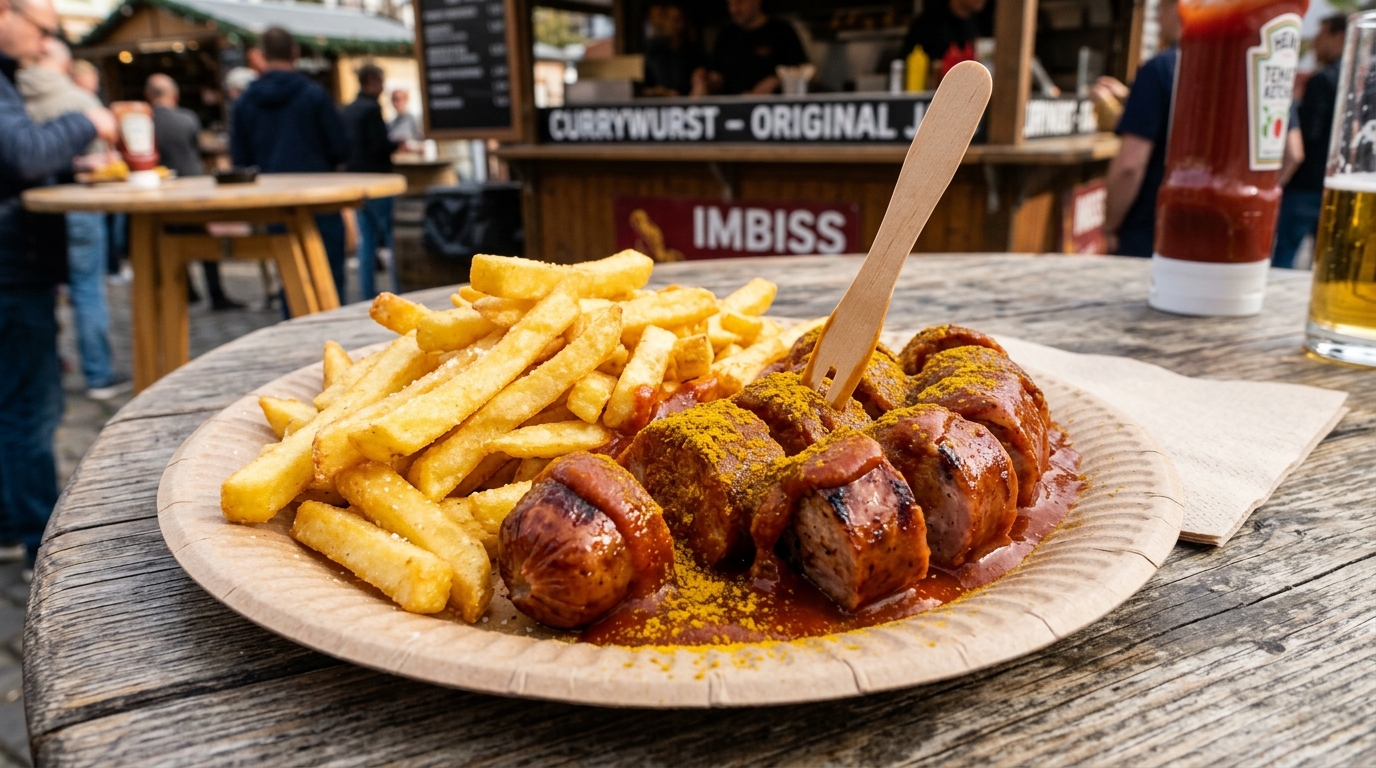
Do not make the mistake of calling Currywurst sauce "curry ketchup." While industrial imitations squeeze generic curry ketchup out of plastic bottles, authentic Berlin Imbiss stands treat their sauce recipes like closely guarded state secrets:
- The Sausage Base: The sausage must have real substance—a robust pork bratwurst (or beef/pork blend) that has been gently steamed and then fried to a golden crisp on a flat-top griddle or plunged into a dedicated fryer.
- The Sauce: Simmered slowly from tomato paste, caramelized onions, vinegar, fruit compote (often apple puree or plum reduction for acidity and natural sweetness), and a touch of dark syrup or cola, the sauce strikes a delicate equilibrium between tangy, sweet, and savory.
- The Powder: The yellow curry blend snowed generously over the top is not traditional Indian garam masala; it is a turmeric-heavy, sweet-aromatic Madras-style blend. When the dry spice contacts the steaming sauce, the heat blooms the essential oils, creating that unmistakable aroma that guides hungry pedestrians down subway stairs from a block away.
The great theological divide of Berlin Currywurst is "Mit oder ohne Darm?" (with or without natural casing). This is not just a texture preference—it is a piece of Cold War history. In former West Berlin (anchored by Curry 36 on Mehringdamm), the tradition is mit Darm, delivering that crisp, snappy bite. In former East Berlin, meat rationing made natural intestinal casings scarce; legendary Prenzlauer Berg butcher Max Konnopke responded in 1960 by creating a smooth, skinless sausage (ohne Darm) that fries up with a tender crust. Order mit Darm in Kreuzberg and ohne Darm under the tracks at Konnopke's to taste both halves of divided Berlin. Always carry physical euro coins—card readers are frequently absent at old-school kiosks.
The Essential Imbiss Trail: Where to Eat
Every neighborhood has its fierce loyalties, but any serious pilgrimage must include these historic bastions:
- Curry 36 (Kreuzberg): Located at Mehringdamm 36 right outside U-Bahnhof Mehringdamm. The neon-lit ground zero of West Berlin nightlife culture. Open until the early morning hours, it serves flawlessly crispy sausages (including an exceptional house-made organic vegan alternative) paired with golden fries and thick house mayonnaise.
- Konnopke’s Imbiss (Prenzlauer Berg): Tucked directly beneath the elevated green iron viaduct of the U2 subway line at Eberswalder Straße. Slinging sausages since 1930, Konnopke’s introduced the Currywurst to East Berlin in 1960. Eating a currywurst while the U-Bahn rumbles overhead is an essential Berlin sensory ritual.
- Curry & Chili (Wedding): For adrenaline junkies, this unassuming kiosk at U-Bahnhof Osloer Straße features an escalating, ten-tier Scoville scale that starts at a mild prickle and ascends into liquid fire powered by ghost peppers and Carolina Reapers.
- Krasselt’s (Steglitz): A beloved local institution in southwestern Berlin since 1959, famous for its velvety, slightly sweeter homemade sauce and traditional wooden skewers.
The Sacred Sidekick: Pommes Rot-Weiß
Ordering a Currywurst without Pommes (fries) is a culinary misstep. The fries are not merely an afterthought; they are the structural delivery vehicle for the leftover puddle of spiced tomato sauce on your paper tray.
In Berlin, the default standard is Pommes Rot-Weiß ("Red and White")—a generous ladle of spiced ketchup countered by a mountain of creamy German mayonnaise. The rich, fatty tang of the mayonnaise tempers the sharp acidity of the tomato sauce and softens the sting of the curry powder, creating a harmonious mess that you will inevitably wipe off your fingers with a paper napkin.
How to Order Like a Local
When you reach the front of the queue, do not hesitate or start browsing your phone. Imbiss counter staff are legendary for their gruff, dry Berlin humor (Berliner Schnauze) and prize efficiency above all:
- Choose your casing: Decide between mit Darm (snappy casing) or ohne Darm (skinless).
- Choose your side: Order either a crusty bread roll (Brötchen or Schrippe) or fries (Pommes Rot-Weiß).
- The Golden Phrase: "Einmal Currywurst mit Darm und Pommes Rot-Weiß, bitte." (One currywurst with casing and fries red-and-white, please).
- Have your cash ready: Hand over your coins, step aside to the metal counter, and enjoy the greasy heartbeat of the German capital.


Comments
Post a Comment